D:

on Saturday, July 30, 2011
The first Ph Ch exam was hard. That was expected of course. What pains me though is that I hadn't been able to finish it. Anyway here's the reviewer I made for the said exam.

Sorry for the size. Just click on it to view it better. :)

Keep Calm and Carry On

on Saturday, July 23, 2011
Chem 18 exam on Wednesday and Chem18. 1 & Ph Ch 125 exam on Saturday. The dates are looming and I am not yet prepared. T___T


Resonance Structures

on Friday, July 15, 2011

Lewis structures that are equivalent except for the placement of electrons are called resonance structures or resonance forms and the hypothetical switching from one resonance structure to another through electron delocalization is called resonance. By convention, resonance structures are separated by double headed arrows.
Seen above are the resonance structures of the ozone molecule. Notice that the only difference between the two structures is in the placement of the double bond and the placement of the lone pair.

Resonance structures are possible whenever there is a multiple bond and an adjacent atom with at least one lone pair. For example, the two resonance structures for the formate ion, HCO2- are
As represented by the arrows, in order to generate the second resonance structure from the first, one lone pair is turned into another bond, thus forming a double bond and consequently, this causes one bond to turn into a lone pair.

The general way of deriving resonance structures from one another is through shifting one of the lone pairs to and adjacent atom to form another bond and through shifting one of the bonds in a double or triple bond up to form a lone pair. This should not be applied to all cases though as the atoms' electronegativities should also be considered. For example, in fluoroethene, CH2CHF,
the resonance structure on the right is not reasonable as fluorine is the most electronegative element and in order to for it to form two bonds and two lone pairs, it would first have to lose an electron.

It is also possible to form resonance structures without the participation of lone pairs. An example is the benzene ring which involves a cycle of double bonds.
It should be taken into consideration that in drawing resonance structures, only the electrons may be moved. The nuclei of the atoms are fixed. The total charge and the total number of electrons are fixed as well.

With all the rules and all the other things to be considered, I find this lesson complicated. :c

3: Isomerism

on Tuesday, July 5, 2011
Isomers are compounds with the same molecular formula but with different structural formulas. As part of the lesson, the professor drew structures in front and our task was to determine whether the said structures were isomers or just the same compound.

It is easy to determine that the compounds above are isomers based on which carbon the amino group (NH2) is attached. On the structure at the left, NH2 is attached to the 2nd carbon. For the one in the middle, NH2 is attached on the 3rd carbon and for the last one, NH2 is seen on the 4th carbon thus proving the difference on their structural formulas.
On this example, the compounds are also isomers as N is placed differently on each compound. To make sure that the compounds are really isomers and not just the same structure, one may try naming each one. Variations in the name generated such as with that seen above already indicate that their structural formulas differ from each other.

The concept of isomerism is basically simple to understand given that one already understands fully how to name structural formulas. In my perspective, the confusing part that may lead to errors in distinguishing identical structures from isomers is in the numbering of the longest carbon chain but once the skills in naming is mastered, I suppose that there wouldn't be further problems regarding the topic.


2: Atomic and Molecular Orbitals

on Tuesday, June 28, 2011
Atomic orbitals are the regions in space where it is more probable to find an electron. This is somehow synonymous to the definition of molecular orbitals though for the latter, the electrons belong to the entire molecule and not to its individual atoms. Another way to put it is that an electron in an atomic orbital is under the influence of only one nucleus of the atom while an electron in a molecular orbital is under the influence of two or more nuclei, depending upon the number of atoms present in the molecule.
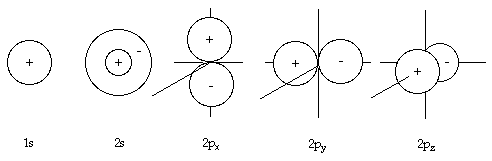
The 1s atomic orbital has no node (region where there is zero probability of finding an electron) and has the lowest energy. The 2s atomic orbital is bigger than 1s and is with one node, thus it has higher energy compared to 1s (as more nodes mean higher energy for the orbital). On the three 2p orbitals, the x, y, or z label indicates along which axis the two lobes are directed. It is also understood that in orbital labels, the number tells the principal energy level while the letter tells the shape. The letter s means a spherical orbital; the letter p means a two-lobed orbital.

All the topics above have already been discussed during our Chem14 days thus it wasn't that hard to understand that part of the lecture. The more complicated orbitals though need a bit more refreshing as they are much harder to visualize. If you want to get a better glimpse of them, click here. :)

1: The Basics

on Wednesday, June 22, 2011
The class started with a brief introduction of our professor, Sir West. That was then followed by our introduction of our chosen partners. As today was our first meeting for Ph Ch 125 lec, the main goal was just to acquaint ourselves with the syllabus and the subject itself. Based on the list of topics covered and on the number of those who have to repeat the subject as well, I can already foresee the looming days of stress and hardship. My lack of background on topics 7 onward may also account for such negativity. I am quite positive on one thing though. Sir West said that organic chemistry allows him to think visually and that is possibly a good thing for visual learners like me.

Organic chemistry is a branch of chemistry that focuses on carbon-containing compounds. Life itself will not be possible without the unique ability of carbon to form multiple chains and rings at low energies. This property of carbon may be attributed to its four valence electrons that readily allow bonding to as many as four other atoms. Though silicon is tetravalent as well, it doesn't tend to form double and triple bonds and its high affinity for oxygen is quite disadvantageous (an example is in the formation of silicon dioxide).

It must be taken into consideration though that not all carbon-containing compounds are organic, with carbon dioxide and carbon monoxide as some examples. As I do not know the reason for this, I have tried to look for answers and according to what I have read, a fine line between organic chemistry and inorganic chemistry doesn't exist though some consider the presence of both carbon and hydrogen as the main determining factor as to whether a compound is organic or not.